The Short Answer
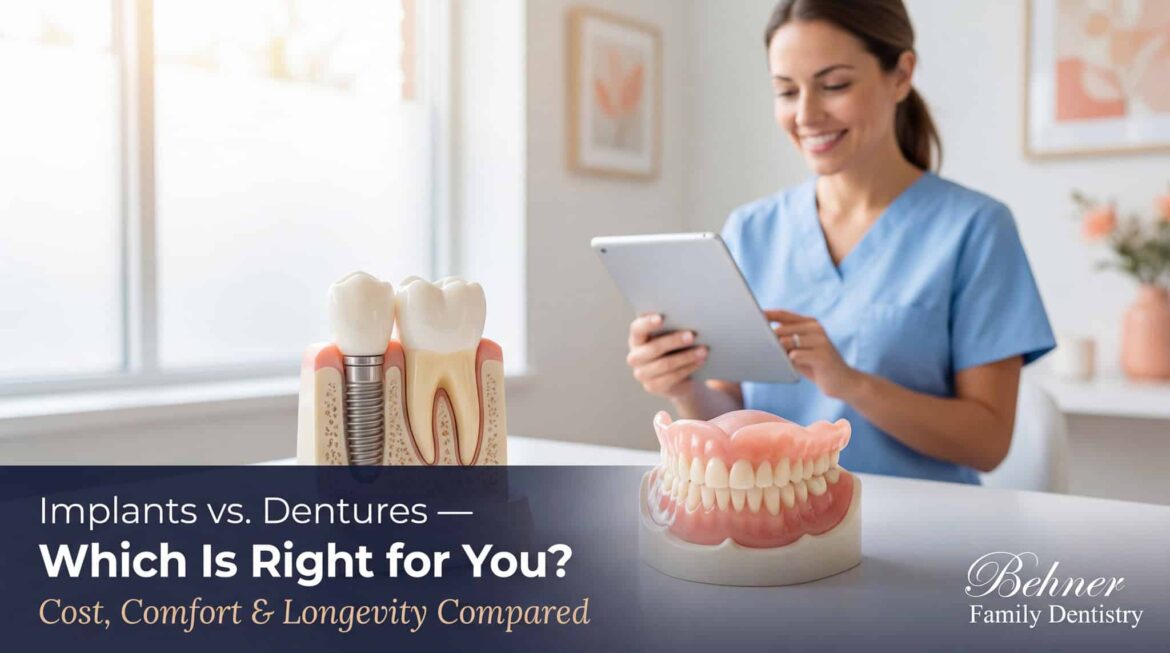
Dental implants are the closest thing to natural teeth available in modern dentistry. They’re permanent, bone-anchored restorations that look, feel, and function like real teeth. They cost more upfront but typically last a lifetime with proper care.
Dentures are removable appliances that sit on the gums and replace a full arch or partial set of teeth. They’re significantly less expensive initially and can be a practical solution — but they come with real tradeoffs in comfort, stability, and long-term bone health.
Neither option is universally right. The best choice depends on your health, bone density, budget, and what daily life with your teeth looks like.
What Are Dental Implants?
A dental implant is a titanium post surgically placed into the jawbone, where it fuses with the bone through a process called osseointegration. Once healed, a crown is attached to the post, creating a fully functional tooth replacement that is anchored in your jaw — not resting on it.
Implants can replace a single tooth, multiple teeth, or an entire arch (as in implant-supported dentures or full-arch “All-on-4” restorations).
What the Implant Process Looks Like
The implant process takes longer than getting dentures — typically three to six months from placement to final restoration — because the bone needs time to fuse with the titanium post. The general timeline:
- Consultation, X-rays, and 3D imaging to assess bone volume
- Implant post placement (outpatient surgical procedure)
- Healing period — typically three to six months
- Abutment placement (the connector between post and crown)
- Final crown attachment
If bone loss has already occurred — which is common with long-term tooth loss — a bone graft may be needed before implant placement, adding time and cost to the process.
What Are Dentures?
Dentures are removable prosthetics designed to replace missing teeth. They come in two main types:
- Full dentures replace an entire upper or lower arch of teeth. They sit on the gums and are held in place by suction, the natural contours of the mouth, and/or denture adhesive.
- Partial dentures replace several missing teeth when healthy natural teeth remain. They’re anchored with clasps to the surrounding teeth.
Implant-supported dentures — sometimes called snap-in dentures or overdentures — are a hybrid option that uses two to four implants to anchor a removable denture in place. This significantly improves stability without the full cost of individual implants for each tooth.
What the Denture Process Looks Like
Getting conventional dentures is faster than implants — typically a few weeks to a couple of months, depending on whether extractions are needed. The process involves impressions, fitting appointments, and adjustments. Immediate dentures can sometimes be placed the same day as extractions, though they’ll require refitting as the gums heal and change shape.
Side-by-Side Comparison
Comfort and Feel
Implants feel like natural teeth. Because they’re anchored in bone, you don’t think about them when you eat, speak, or smile. There’s no movement, no slipping, no adhesive. Patients consistently report that implants are the most comfortable long-term option.
Dentures require an adjustment period — often weeks to months — as your mouth adapts to the appliance. Conventional full dentures can shift during eating and speaking, which many patients find frustrating. Sore spots on the gums are common early on. Over time, as the jawbone changes shape (more on this below), dentures may need relining or replacement to maintain a proper fit.
Implant-supported dentures dramatically improve stability over conventional dentures, though they still require removal for cleaning.
Chewing and Function
Implants restore nearly full chewing force — close to what you had with natural teeth. You can eat what you want, including hard or crunchy foods, without restriction.
Dentures reduce chewing efficiency significantly. Studies estimate denture wearers use roughly 20–25% of their original chewing force compared to natural teeth. Hard foods, sticky foods, and tough meats can be challenging or off-limits, particularly with lower dentures, which have less suction stability.
This isn’t a small quality-of-life detail. For many patients — especially those who are active or health-focused — dietary restrictions become a meaningful long-term concern.
Bone Health
This is one of the most clinically significant differences between the two options, and it’s often underemphasized in casual comparisons.
When a tooth is lost, the jawbone underneath it begins to resorb — it shrinks because there’s no longer a root stimulating it. Dental implants mimic tooth roots and transmit chewing forces into the bone, which preserves bone density over time.
Dentures do not stimulate the bone. They rest on top of the gums, and the bone underneath continues to resorb. Over years, this bone loss changes the shape of the jaw and face — often creating a “sunken” facial appearance — and causes the denture to fit progressively less well. This is why dentures typically need to be relined or replaced every five to ten years.
For younger patients or those with significant remaining bone, this long-term trajectory is worth weighing carefully.
Appearance
Both implants and modern dentures can look very natural. High-quality acrylic and porcelain dentures are cosmetically refined and custom-fitted to your facial structure.
Over time, however, the bone resorption that occurs with dentures changes the appearance of the lower face. The lips may appear thinner, the chin more prominent, and the overall profile older-looking. Implants, by preserving bone, tend to maintain facial structure better over decades.
Maintenance
Implants are maintained exactly like natural teeth — brush twice daily, floss around the implant, and attend regular dental cleanings. No removal, no soaking, no adhesive.
Dentures require daily removal and cleaning with a denture brush and soaking solution. They should be kept moist when not worn to prevent warping. Regular checkups are still important to assess fit, examine the gums and remaining bone, and catch any issues early.
Cost: The Honest Breakdown
This is where most patients start — but it’s important to look at cost over a full time horizon, not just the initial price tag.
Dental Implant Costs
A single dental implant — including the post, abutment, and crown — typically ranges from $3,000 to $5,000 per tooth in the Altamonte Springs area, depending on the complexity, whether a bone graft is needed, and the materials used. Full-arch implant restorations (All-on-4 or All-on-X) range considerably higher.
Dental insurance covers implants inconsistently — many plans still classify them as cosmetic, though this is changing. Dental savings plans and financing options (like CareCredit) are commonly used to manage the upfront cost.
Long-term cost: A well-placed implant with proper care can last 20 to 30 years or longer — many patients keep them for life. The crown portion may eventually need replacement, but the implant post itself rarely fails.
Denture Costs
Full conventional dentures typically range from $1,000 to $3,000 per arch, depending on materials and the dental practice. Implant-supported dentures cost more — generally $3,500 to $30,000 or more depending on the number of implants and type of restoration.
Dental insurance is more likely to provide partial coverage for dentures than for implants.
Long-term cost: Dentures typically need relining every one to two years and full replacement every five to ten years. The cumulative cost over 20 to 30 years — including replacements, adhesives, and adjustments — can approach or exceed the cost of implants, without the functional and bone-health benefits.
Which Option Is Right for You?
There’s no universal answer, but here are the general frameworks most dentists and patients use:
Dental implants tend to be the better long-term investment if:
- You’re missing one to several teeth and have adequate bone density
- You want a permanent, low-maintenance solution
- Long-term bone health and facial structure matter to you
- You want to eat without dietary restrictions
- You’re willing to invest more upfront for a better long-term outcome
Dentures may be the more practical choice if:
- You’re missing all or most of your teeth and implants aren’t financially feasible right now
- Significant bone loss makes implant placement complex or impossible without extensive grafting
- Medical conditions affect your candidacy for surgery
- You need a faster solution
- Budget is the primary constraint in the short term
Implant-supported dentures are worth exploring if:
- You want better stability than conventional dentures
- You’re not a candidate for full individual implants but want a more secure fit
- You’re looking for a middle path on cost and function
Getting a Tooth Replacement Consultation in Altamonte Springs
The best way to know which option makes sense for you is a proper evaluation. Your dentist will review your bone density (via X-ray or CT scan), your overall health, your budget, and your goals — and walk you through what’s realistic and what will serve you best long term.
Don’t let uncertainty keep you from replacing missing teeth. Whether the answer is implants, dentures, or something in between, acting sooner preserves more options — because the longer bone loss is allowed to progress, the more limited the path to the best outcome becomes.
Reach out to your Altamonte Springs dental office to schedule a tooth replacement consultation and get a clear picture of what’s right for your situation.
People Also Ask
Are dental implants worth the extra cost over dentures?
For most patients with adequate bone and no major health contraindications, yes — particularly when viewed over a 20-to-30-year horizon. Implants preserve bone, restore full function, and don’t require replacement or adhesive. The total cost of dentures over the same period often comes closer to implant costs than the upfront price difference suggests.
Can you get implants if you’ve worn dentures for years?
Possibly, but bone loss from long-term denture wear may require bone grafting before implants can be placed. A CT scan will determine how much bone remains and what your options are.
Do dental implants hurt?
The surgical placement is done under local anesthesia and sometimes sedation. Post-procedure soreness is normal for a few days and managed with over-the-counter pain relievers. Most patients report it’s more comfortable than they anticipated.
How long do dentures last?
Conventional dentures typically last five to ten years before needing replacement, though they often require relining sooner as the jaw changes shape. Implants can last 20 to 30 years or more.
Does insurance cover dental implants or dentures?
Dentures are more commonly covered (partially) by dental insurance. Implant coverage varies widely by plan — many still classify them as cosmetic, though more plans are beginning to offer partial coverage. It’s worth calling your insurer directly to verify your benefits before treatment planning.
What are snap-in dentures?
Snap-in dentures (implant-supported overdentures) are removable dentures anchored by two to four implants. They offer significantly better stability than conventional dentures and help slow bone resorption in the areas where implants are placed.